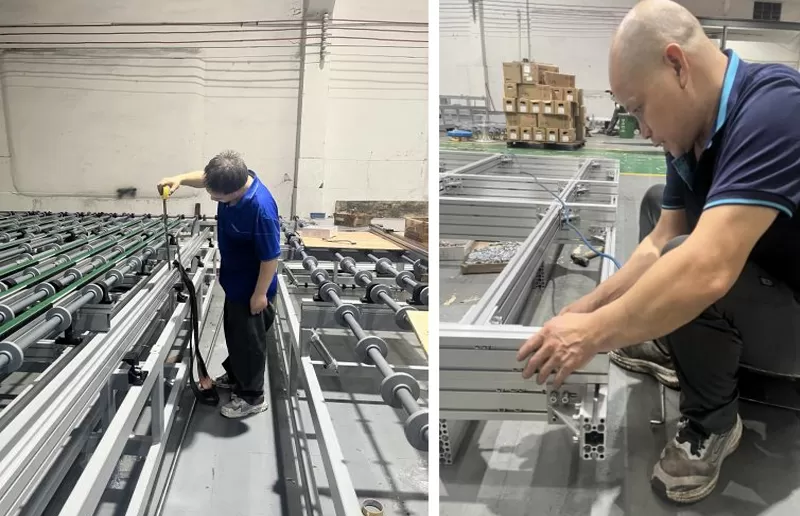
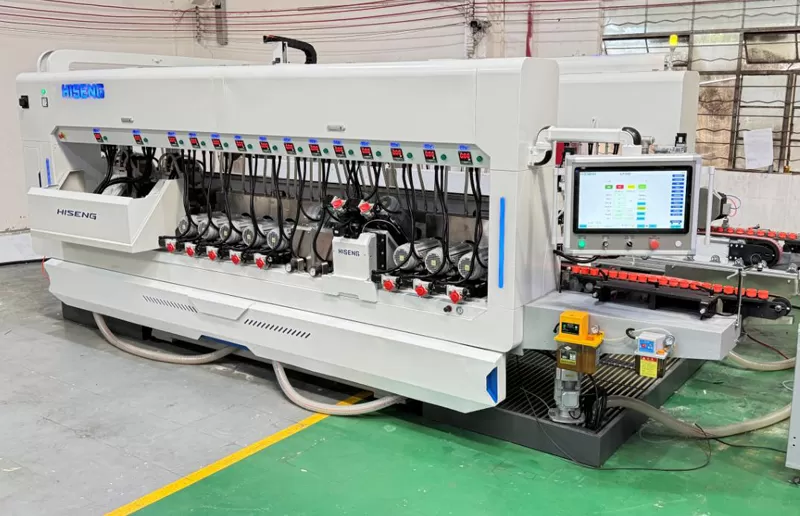
A glass edge machine is industrial equipment used to grind, refine and polish the edges of cut glass.
After a glass sheet is cut and broken to size, its edges may contain sharp arrises, small chips, overbreaks, underbreaks and microscopic cracks. A glass edge machine removes or controls these irregularities and produces an edge that meets the dimensional, safety and visual requirements of the finished product.
Depending on its configuration, the machine may create a simple seamed edge, a flat ground edge, a transparent polished edge, a rounded pencil edge or a decorative bevel.
Glass edge machines are widely used in the production of architectural glass, shower doors, furniture, mirrors, appliance panels, solar glass, automotive components and other processed-glass products.
A glass edge machine, also called a glass edging machine or glass edger, is a machine that uses abrasive wheels or belts to remove material from the edge of a glass sheet.
The machine guides the glass past a controlled sequence of grinding and polishing tools. Each tool performs a different stage of the process, from removing rough material to refining the edge and producing the required finish.
A typical machine may perform several operations in one pass:
Rough grinding
Fine grinding
Edge sizing
Arris grinding
Chamfering
Polishing
Corner processing
The exact process depends on the machine type, wheel arrangement and required edge profile.
Cutting does not normally create a finished edge.
After a cutting wheel scores the surface and the glass is broken along the score line, the resulting edge may contain irregular fractures and very sharp corners. LiSEC notes that untreated cut edges can include overbreaks, underbreaks, conchoidal fractures and microcracks. Sharp edges also increase the risk of injury and damage during handling and transport.
Edge processing is therefore used to achieve four main objectives.
Removing sharp arrises reduces the risk of cuts to operators, installers and end users.
Even when the glass edge will eventually be hidden inside a frame, seaming or grinding can make the sheet safer to transport and process.
Fine grinding can remove a controlled amount of material and bring the glass to its specified final size.
This is important for products that must fit accurately into frames, channels, insulating-glass systems or assembled components.
Visible glass edges may require a smooth, clear and uniform finish.
Furniture glass, mirrors, shelves and shower panels often use polished or rounded edges because the edge remains visible in the completed product.
Glass may be edged before:
Tempering
Laminating
Insulating-glass assembly
Printing
Coating
Drilling
Final assembly
The edge specification should be determined according to the downstream process and final application.
A glass edge machine processes the edge through a controlled sequence of feeding, grinding, cooling and polishing.
Although machine designs vary, the basic operating principle is similar.
The operator or automatic loading system places the cut glass onto the machine.
On a vertical edger, the glass stands upright and is supported by conveyor pads, belts or rollers. On a horizontal machine, the sheet lies flat on a conveyor or worktable.
The glass must be positioned securely so that it moves through the processing section without excessive vibration or movement.
Before production begins, the operator normally enters or confirms parameters such as:
Glass thickness
Processing speed
Grinding amount
Edge type
Required dimensions
Machine recipe
Automated systems may detect glass dimensions and adjust the machine accordingly.
The conveying system moves the glass past the grinding wheels at a controlled speed.
Stable movement is essential because vibration can lead to:
Uneven grinding
Chipping
Irregular arrises
Inconsistent dimensions
Poor polishing
Glass breakage
LiSEC identifies stable glass guidance and vibration control as important technical requirements, particularly when high-speed grinding tools are used.
The machine frame, conveyor, clamping pressure and transmission system must therefore work together to keep the sheet stable.
Rough grinding is the first major material-removal stage.
Diamond grinding wheels with a relatively coarse abrasive structure remove the sharp, irregular or oversized part of the glass edge.
Rough grinding may be used to:
Remove cutting defects
Correct the glass size
Establish the basic edge shape
Prepare the surface for finer wheels
Form the initial arrises
This stage removes material efficiently, but it does not normally produce the final visual finish.
The edge generally remains matte and shows visible grinding marks after rough grinding.
Fine grinding uses finer abrasive wheels to refine the surface created during rough grinding.
It reduces the depth of the earlier grinding marks and produces a smoother, more consistent edge.
Fine grinding may also be used for precise dimensional correction. According to LiSEC, this process can bring a glass sheet to an exact final size while producing a more homogeneous grinding pattern.
The operating speed, grinding pressure and stock-removal amount must be coordinated. Excessive pressure or speed can create chips, heat and inconsistent edge quality.
A flat glass edge normally has two sharp intersections where the edge meets the front and rear glass surfaces.
These corners are commonly referred to as arrises.
Dedicated wheels may lightly grind the upper and lower arrises to create:
A seamed arris
A small chamfer
A controlled flat arris
A rounded transition
The required arris width depends on the product specification.
Architectural glass may require consistent arrises for processing and safety, while exposed furniture glass may require a more attractive and highly polished transition.
Polishing is the finishing stage used when a smooth, visually clear edge is required.
Polishing tools remove the fine grinding pattern and improve the optical appearance of the edge.
LiSEC describes polished glass edges as transparent and uniform, with visual characteristics approaching those of the flat glass surface. Polishing is therefore commonly used where the finished edge remains visible.
The polishing result depends on:
Tool material
Wheel condition
Wheel pressure
Feed speed
Water quality
Glass composition
Quality of the previous grinding stages
Polishing cannot fully compensate for poor rough or fine grinding. Each earlier stage must prepare a consistent surface for the next wheel.
Glass edging is normally a wet process.
Water or an appropriate coolant is directed at the contact area between the glass and the processing tool.
The cooling system performs three important functions:
It removes glass particles from the processing area.
It cools the grinding or polishing tool.
It limits heat input into the glass.
Excessive heat can reduce edge quality and negatively affect the glass. Controlled cooling is therefore an essential part of stable edge processing.
The used water may pass through settling tanks, filters or treatment systems before being reused or discharged.
After edging, the glass exits the machine and should be inspected.
Quality checks may include:
Edge profile
Surface finish
Chips and shells
Arris width
Glass dimensions
Parallelism
Bevel angle
Round-edge radius
Water marks or residue
In an automated line, the glass may move directly to a washing machine, inspection station, drilling machine or tempering line.
A glass edge grinding machine combines structural, mechanical, abrasive, cooling and electronic systems.
| Component | Main function |
|---|---|
| Machine frame | Supports the processing units and limits vibration |
| Conveyor system | Moves the glass through the machine at a controlled speed |
| Clamping or pressure system | Keeps the glass stable during processing |
| Grinding spindles | Drive the grinding and polishing wheels |
| Rough grinding wheels | Remove cutting defects and excess material |
| Fine grinding wheels | Refine the surface and control final dimensions |
| Arris wheels | Process the front and rear edge corners |
| Polishing wheels | Produce a smoother and clearer finish |
| Water-cooling system | Cools tools and glass while removing particles |
| Water tank and filter | Collect and manage grinding water and debris |
| Motors and drives | Control spindle and conveyor movement |
| PLC and HMI | Allow operators to set and monitor processing parameters |
| Sensors | Detect glass position, thickness or machine status |
| Safety system | Protects operators and stops the machine during abnormal conditions |
The number and arrangement of spindles vary considerably between machines.
More spindles may allow additional grinding and polishing stages, but spindle count alone does not determine machine quality. Frame stability, wheel configuration, control accuracy and tool selection are equally important.
These processes are related, but they do not produce the same result.
| Process | Main purpose | Typical surface appearance | Dimensional change |
|---|---|---|---|
| Seaming | Remove sharp arrises | Rough and non-decorative | Minimal |
| Rough grinding | Remove material and cutting defects | Clearly matte and structured | Yes |
| Fine grinding | Refine the surface and control size | Smoother matte finish | Yes |
| Polishing | Produce a smooth, visually clear edge | Transparent or glossy | Minor final refinement |
Seaming is the simplest edge treatment. It removes sharp corners without grinding the entire edge surface or significantly changing the sheet dimensions.
Grinding removes more material and may be used to achieve the final size.
Polishing is selected when a high visual standard is required.
The available finish depends on the machine design and tooling.
| Edge finish | Description | Common applications |
|---|---|---|
| Seamed edge | Sharp arrises are lightly removed; the main edge remains rough | Hidden edges and pre-tempering preparation |
| Ground edge | Entire edge is ground but remains matte | Framed architectural and industrial glass |
| Flat polished edge | Flat edge with a smooth, transparent finish | Doors, partitions, shelves and furniture |
| Pencil edge | Rounded or C-shaped edge | Tabletops, appliance shelves and exposed glass |
| Beveled edge | Angled polished surface extending from the glass face | Mirrors and decorative interior glass |
| Mitered edge | Edge processed to a specified joining angle | Angled assemblies and structural details |
| Chamfered edge | Small angled section removes a sharp corner | Safety and assembly applications |
The terms used by suppliers and buyers are not always identical. A purchaser should therefore provide a drawing, edge sample or measurable specification rather than relying on the edge name alone.
A machine does not produce the same result under every operating condition.
Large chips, poor scoring or irregular break lines increase the amount of material that the edging machine must remove.
Stable cutting improves the consistency of the subsequent grinding process.
Wheel grit, profile, diameter, bond and material must match the glass and required finish.
An unsuitable wheel may create:
Excessive chipping
Deep grinding marks
Poor polish
Rapid wheel wear
Excessive heat
Higher feed speed can increase output, but the wheels have less time to process each section of the edge.
The correct speed depends on the glass thickness, stock-removal amount, edge profile and required quality.
Insufficient pressure may leave parts of the edge unfinished. Excessive pressure can cause heat, wheel wear, chips or glass breakage.
Automatic wheel compensation and motor-load monitoring can help stabilize this variable.
The water flow must reach the grinding contact area consistently.
Poor cooling or blocked nozzles can increase temperature and allow glass powder to remain between the tool and the edge.
Frame rigidity, spindle condition, bearing quality and conveyor alignment all affect vibration and edge consistency.
Worn or incorrectly dressed wheels produce lower-quality results.
Operators should inspect wheel wear and replace or adjust tools according to the supplier’s maintenance instructions.
The primary safety benefit comes from removing sharp edges and controlling cutting defects.
Proper edge processing can:
Reduce the risk of cuts during handling
Remove sharp arrises
Reduce severe chips and irregular fractures
Improve dimensional consistency
Produce repeatable edge profiles
Improve the appearance of exposed edges
Prepare the glass for subsequent production steps
However, it is inaccurate to assume that every grinding process automatically increases glass strength.
Poor wheel selection, high vibration, excessive temperature or inappropriate post-processing can introduce new defects. The value of a glass edge machine therefore depends on process control as well as machine automation.
Edge grinding, drilling, cutting and other operations that alter the glass should normally be completed before heat treatment.
The National Glass Association’s technical material notes that standards for heat-treated glass require edge-altering fabrication to be performed before heat treatment to avoid reducing glass strength. It also warns that post-fabrication edge finishing can reduce the edge-compression layer of heat-treated glass.
A typical sequence is therefore:
Cut the glass.
Grind, seam or polish the edges.
Drill holes or create cut-outs.
Wash and inspect the glass.
Heat-strengthen or temper the finished sheet.
After tempering, the glass should not normally be cut, drilled or substantially ground.
Any exceptional post-treatment work should be evaluated according to the relevant glass standard, application and fabricator recommendations.
A straight line edger processes one straight edge during each pass. It is commonly used for rectangular architectural, furniture and interior glass.
A double edging machine processes two opposite edges simultaneously. It is suitable for high-volume production of rectangular glass.
This machine creates rounded edges on two opposite sides and is commonly used for furniture, appliance and solar glass.
A glass beveling machine creates and polishes an angled decorative surface along the edge.
A shape edging machine follows circular, oval or irregular contours.
A seaming machine removes sharp arrises and small edge defects, often before tempering or insulating-glass production.
The HISENG product range includes double edging machines, double round edging machines, jumbo bilateral edgers, seamers, vertical edge grinding machines, washers and related automated glass-processing equipment.
Guangdong HISENG Glass Machinery Co., Ltd. was established in 2006 and specializes in glass edging equipment and automated glass-processing systems. Its portfolio includes glass edgers, double edging machines, seamers, washers, drilling machines and related automation equipment.
According to the company’s published information, HISENG provides:
Customized production-line layouts
Straight-line and double-side edging solutions
Multi-servo and frequency-conversion control
Connections with upstream and downstream equipment
ERP and MES data communication
Installation and technical support
The company states that it exports more than 400 machines annually to over 120 countries and regions. As this is company-reported information, buyers should still evaluate the relevant model through technical documentation, sample processing and reference installations.
A suitable machine recommendation should be based on the buyer’s actual:
Glass size
Glass thickness
Edge profile
Daily output
Factory layout
Downstream production process
Automation requirements
A glass edge machine is industrial equipment that grinds, refines or polishes the edges of cut glass to produce a safer, more accurate or more attractive finished edge.
The machine conveys glass past a sequence of abrasive wheels. Rough wheels remove material, fine wheels refine the surface, arris wheels process the corners and polishing wheels create the final visual finish. Water cools the tools and removes glass particles.
Grinding removes material, corrects dimensions and creates the basic edge shape. Polishing uses finer tools to remove the grinding pattern and produce a smoother, clearer surface.
Water cools the processing tool and glass, flushes away glass particles and limits heat buildup at the grinding point.
No. Machine design, spindle arrangement and tooling determine the available edge profiles. A standard flat-edge machine should not automatically be assumed to produce pencil, bevel or complex shaped edges.
Properly controlled edge processing can remove cutting defects and improve edge consistency. However, poor grinding conditions can introduce damage. Edge quality depends on wheel selection, cooling, vibration, pressure and process control.
Substantial edge processing should normally be completed before tempering. Cutting, drilling or grinding heat-treated glass can reduce its strength or cause failure.
Seaming lightly removes sharp arrises and leaves a relatively rough edge. Polishing processes the complete edge to create a smooth and visually clear finish.
There is no universal number. The correct configuration depends on the edge type, removal amount, glass thickness, required finish and target processing speed.
The buyer should process representative glass samples at the required production speed and inspect dimensions, arris consistency, chips, grinding marks, polish, water residue and downstream performance.
A glass edge machine transforms a rough cut edge into a controlled edge that is safer to handle, more dimensionally accurate and more suitable for the final application.
The process usually combines stable conveying, rough grinding, fine grinding, arris processing, polishing and water cooling. Each stage must be correctly coordinated because the final result depends on more than the number of wheels or the maximum machine speed.
Manufacturers should define the required edge profile, glass dimensions, thickness, output and downstream process before selecting equipment. They should also test real glass samples and confirm that the machine can maintain the required quality during continuous production.
With the correct machine configuration and process control, glass edging becomes an integrated quality step rather than simply a method of removing sharp material.


 EN
EN
 jp
jp  fr
fr  de
de  fa
fa  es
es  ru
ru  pt
pt  tr
tr  ar
ar  vi
vi