Different types of glass edge machines are designed to produce different edge profiles, process different glass shapes and meet different production-volume requirements.
A straight line edger produces flat polished edges on rectangular glass. A beveling machine creates an angled decorative surface along the edge. A pencil edger produces rounded edges, while a double edging machine processes two opposite sides simultaneously. For circles, ovals and irregular panels, manufacturers normally use a shape edging machine.
Choosing the wrong machine can lead to limited product capability, unnecessary handling, slow output or an edge profile that does not meet the final application.
This guide explains how the main glass edging machines work, where each type is used and how glass processors can compare them.
The five commonly compared categories are:
Glass straight line edging machine
Glass beveling machine
Glass pencil edging machine
Glass straight line double edging machine
Glass shape edging machine
These names may describe different aspects of a machine.
“Straight line” describes the path of the glass.
“Bevel” and “pencil” describe the finished edge profile.
“Double edging” describes how many opposite sides are processed simultaneously.
“Shape edging” describes the geometry of the glass being processed.
This distinction is important because two machines may both process straight glass while producing completely different edge profiles.
| Machine type | Main edge profile | Suitable glass shape | Typical production mode | Common applications |
|---|---|---|---|---|
| Straight line edger | Flat polished edge with arrises | Rectangular or square | Single-side, continuous | Doors, partitions, furniture and architectural glass |
| Glass beveling machine | Angled decorative bevel | Mainly rectangular or square | Single-side, continuous | Mirrors, decorative doors and interior glass |
| Pencil edger | Rounded or C-shaped edge | Rectangular, square or shaped | Single- or double-side depending on configuration | Furniture, appliance and solar glass |
| Double edging machine | Flat edge with arrises on two sides | Rectangular or square | Two opposite sides simultaneously | High-volume architectural, appliance and IG glass |
| Shape edging machine | Flat, bevel, round or pencil edge | Circular, oval and irregular | Flexible, usually batch-based | Custom furniture, mirrors and specialty glass |
The most suitable machine therefore depends on both the required edge profile and the production method.
A glass straight line edging machine is used to grind and polish one straight edge of rectangular or square glass during each pass.
The glass normally travels vertically through a series of grinding and polishing wheels. Different wheels perform rough grinding, fine grinding, arris processing and polishing before the glass exits the machine.
A standard straight line edger normally produces:
A flat polished edge
Upper and lower arrises
Small chamfers
Straight dimensional edges
The final edge is generally flat rather than rounded. This makes the machine suitable for glass that must fit accurately into frames, channels, seals or assemblies.
Straight line edging machines are widely used for:
Architectural doors
Glass partitions
Shower enclosures
Furniture panels
Shelves
Electronic glass
Appliance components
Interior decorative glass
They are particularly suitable for factories processing varied glass sizes in small or medium production batches.
A straight line edger offers:
Flexible processing of different glass sizes
Relatively simple operation
A smaller footprint than a double edging line
Consistent flat edges
Lower investment than a fully automated bilateral line
Suitability for mixed production
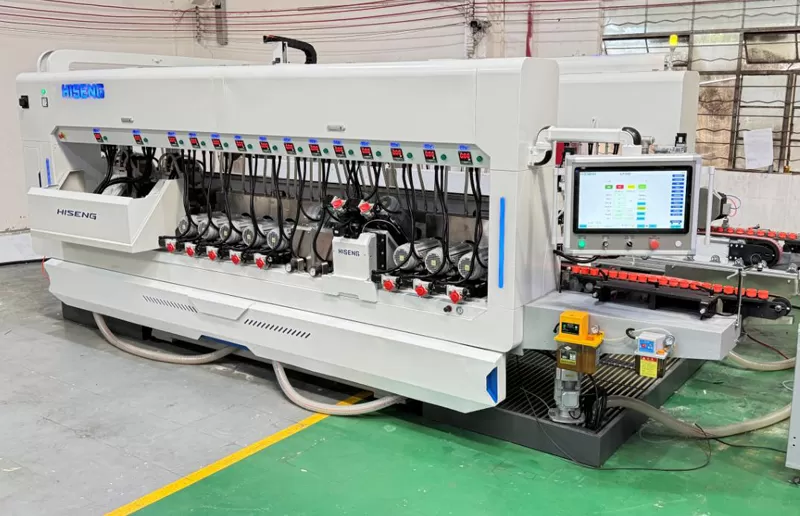
The HISENG HSE-11S, for example, is a vertical glass straight line edging machine designed for architectural and electronic glass. Its published specifications include a 3–25 mm glass thickness range, a minimum glass size of 60 × 80 mm and an adjustable grinding speed of 0.5–5 m/min.
Because only one edge is processed during each pass, rectangular glass may need to be rotated and fed through the machine several times.
A straight line edger is therefore less efficient than a double edging line when a factory continuously produces large batches of standardized rectangular panels.
A glass beveling machine grinds and polishes an angled surface between the front face and the edge of a glass sheet.
Unlike a standard flat polished edge, a bevel creates a sloped surface that reflects and refracts light. It is mainly selected for visual and decorative purposes.
A beveled edge has three main characteristics:
Bevel angle
Bevel width
Polished surface quality
A wider bevel creates a more visible decorative effect, while the selected angle influences the shape and depth of the sloped surface.
Glass beveling machines are commonly used for:
Decorative mirrors
Furniture glass
Interior doors
Display cabinets
Wall panels
Glass partitions
Decorative architectural elements
Premium interior glass products
Beveled glass is often used where the edge remains visible and contributes to the appearance of the finished product.
The glass passes through multiple processing stations. Depending on the machine configuration, these stations may perform:
Rough bevel grinding
Fine grinding
Surface refinement
Bevel polishing
Bottom-edge processing
Using multiple wheels allows the machine to produce the bevel and polish it during one continuous pass.
When comparing beveling machines, check:
Minimum and maximum glass size
Glass thickness range
Maximum bevel width
Adjustable bevel angle
Processing speed
Number and arrangement of wheels
Surface consistency
Changeover requirements
The HISENG HSB-371 glass straight line beveling machine processes 3–19 mm glass. Its published specifications include a bevel-angle range of 3°–18°, a maximum bevel width of 40 mm and a transmission speed of 0.5–5 m/min.
A dedicated beveling machine is appropriate when:
Beveled products form a regular part of the product portfolio
Bevel width and angle must remain consistent
The edge is a visible design feature
Manual beveling creates excessive variation
Decorative glass production requires repeatable output
A beveling machine should not be selected merely because it can remove material from an edge. Its primary value is the controlled decorative bevel that it produces.
A glass pencil edging machine creates a rounded edge profile instead of a flat or angled surface.
The profile is often described as:
Pencil edge
Round edge
C-edge
Bullnose-style edge
The exact terminology varies between markets and manufacturers.
“Pencil edger” is a broad market term describing the edge profile. In an industrial production line, rounded edges may be produced by a glass straight line double round edging machine.
HISENG describes its SYM equipment as a straight line double pencil edger line. It processes two opposite rounded edges and can be configured with functions such as Low-E film deletion or corner dubbing. The company identifies solar glass, furniture glass, appliance glass and automotive glass as relevant applications.
Therefore, buyers should not rely on the phrase “pencil edger” alone. They should determine whether the machine:
Processes one edge or two opposite edges
Handles straight glass or shaped glass
Produces a full round edge or partial radius
Includes polishing
Supports automatic width adjustment
Can process corners in the same line
Rounded glass edges are frequently used for:
Glass tabletops
Shelves
Furniture doors
Refrigerator shelves
Appliance panels
Solar glass
Automotive components
Exposed interior glass
A rounded edge is particularly suitable when the edge remains visible or may be touched during use.
A pencil edge provides:
A smooth exposed edge
A softer visual appearance
No sharp flat-edge corners
Suitability for furniture and appliance products
Compatibility with high-volume double-side processing
However, the required radius and polishing standard must be confirmed through sample testing. “Pencil edge” is not a single universal dimension.
A glass straight line double edging machine, also called a bilateral edger or double edger, processes two opposite sides of rectangular glass simultaneously.
Instead of passing one edge through a single vertical machine, the glass moves horizontally between two parallel grinding units.
A typical line includes:
Glass measurement or checking
Automatic width adjustment
First-pair edge grinding
Glass transfer or rotation
Second-pair edge grinding
Washing and drying
Inspection or unloading
Each side may contain several spindles for rough grinding, fine grinding, arris formation and polishing.
Processing two opposite edges simultaneously reduces the number of separate passes and handling steps required for rectangular glass.
The main benefits include:
High continuous output
Consistent width
Stable parallelism
Reduced glass rotation
Lower manual handling requirements
Integration with washing and transfer equipment
Suitability for automated production
Double edging lines are therefore most appropriate when the factory produces repeated rectangular products at medium or high volume.
Double edging machines are used for:
Architectural glass
Insulating-glass panels
Laminated glass
Low-E glass
Shower glass
Furniture glass
Appliance glass
Façade panels
HISENG’s current straight line double edger category includes HSDN L-Type, HSDN straight-line-layout and SZM high-speed configurations. Published category specifications show model-dependent processing sizes, 3–25 mm glass thickness and transmission speeds of up to 30 m/min.
Depending on the machine configuration, optional functions may include:
Low-E film deletion
Corner cutting or corner dubbing
Automatic grinding feed
Automatic wheel compensation
Recipe storage
ERP or MES communication
Remote monitoring
In-line washing
Buyers should verify which functions are included in the quotation rather than assuming they are standard.
A double edger is less suitable for:
Highly irregular glass
Frequent one-piece custom orders
Circular or oval panels
Factories with insufficient line space
Production volumes too low to justify the automation
The investment should be based on actual product flow, not only the maximum machine speed.
A glass shape edging machine is designed for circular, oval and simple irregular glass that cannot be processed completely by a conventional straight line edger.
Depending on its tooling and design, a shape machine may produce:
Flat edges
Pencil edges
Rounded edges
Beveled edges
Polished shaped profiles
A straight line edger moves a rectangular sheet along a fixed linear path.
A shape edging machine follows the contour of the workpiece. This may be achieved through manual guidance, templates, rotating tables, mechanical arms or CNC-controlled motion.
Because the machine must follow curves and changing directions, shape edging normally prioritizes flexibility rather than maximum continuous-line output.
Shape edging machines are suitable for:
Round tabletops
Oval mirrors
Curved furniture glass
Decorative panels
Appliance windows
Custom shower glass
Specialty interior components
The HISENG HSS-151 is intended for simple special-shaped glass. It can perform rough and fine polishing for bevel, round, oval and pencil edges.
Its published specifications include:
Glass thickness: 3–19 mm
Workpiece diameter: 0.15–2.1 m
Processing angle: 0°–15°
Total power: 5 kW
Different wheel arrangements are used for round-edge and bevel-edge processing.
A conventional shape edger is suitable for relatively simple contours and businesses that need flexible edge processing without a fully automated CNC system.
A CNC glass working center is more appropriate when the factory needs:
Complex programmed contours
High repeatability
Drilling and milling
Internal cut-outs
Multiple processing operations in one setup
Frequent production of complex components
The CNC solution normally requires a higher investment but provides broader processing capabilities.
Some machines are closely related to edge processing but serve different purposes.
A glass seaming machine removes sharp arrises and small edge defects, usually before tempering or insulating-glass production.
Seaming is not the same as producing a fully polished decorative edge. It focuses on fast edge preparation rather than cosmetic finishing.
A mitering machine processes an edge at an adjustable angle. It is often used when glass pieces must form angled joints or specific structural profiles.
A miter is different from a decorative face bevel, even though both involve angled grinding.
A washing machine removes grinding residue, coolant and glass particles after edging. It does not create the edge itself, but it is often integrated into an automatic edging line.
A drilling machine produces holes and cut-outs rather than external edge profiles. Some CNC systems combine drilling, milling and edging, but conventional drilling and edging machines have separate functions.
Although both machine names are commonly used in glass processing, they are based on different classification methods.
| Comparison point | Straight line edger | Pencil edger |
|---|---|---|
| Name refers to | Glass travel and processing path | Finished edge profile |
| Primary edge | Flat polished edge with arrises | Rounded or C-shaped edge |
| Typical glass | Rectangular and square | Rectangular or shaped, depending on machine |
| Main applications | Doors, partitions, architectural and furniture glass | Furniture, appliance, solar and exposed glass |
| Production format | Usually one edge per pass | Single- or double-side |
| Main selection issue | Flatness, arris and dimensional accuracy | Radius, symmetry and polish |
A standard straight line edger should not automatically be assumed to produce a pencil edge. The spindle arrangement and wheel configuration must be designed for the required profile.
| Comparison point | Single straight line edger | Double edging machine |
|---|---|---|
| Edges processed | One edge per pass | Two opposite edges simultaneously |
| Best production type | Mixed sizes and flexible orders | Standardized medium- or high-volume orders |
| Glass shape | Rectangular or square | Rectangular or square |
| Floor-space requirement | Relatively limited | Larger integrated line |
| Automation potential | Moderate | High |
| Initial investment | Lower | Higher |
| Handling requirement | More glass rotation | Less manual rotation |
| Main benefit | Flexibility | Throughput and dimensional consistency |
A smaller processor may receive better value from a flexible single edger. A high-volume factory may reduce handling and increase line continuity with a double edging system.
| Glass application | Recommended machine | Reason |
|---|---|---|
| Architectural doors and partitions | Straight line edger | Flexible flat-edge processing |
| Insulating-glass production | Double edging machine or seaming machine | High-volume rectangular processing |
| Furniture tabletops | Pencil or shape edging machine | Smooth exposed rounded edges |
| Decorative mirrors | Beveling or shape edging machine | Decorative edge profiles |
| Appliance shelves and panels | Double round or double edging machine | Repeatable production and consistent edges |
| Solar glass | Double round edging line | High-volume rounded-edge processing |
| Circular and oval glass | Shape edging machine | Follows curved contours |
| Jumbo façade panels | Jumbo bilateral edger | Supports large and heavy glass |
| Glass prepared for tempering | Seaming or edging machine | Removes sharp edges and defects |
This table provides a starting point. Final machine selection must also consider glass dimensions, thickness, tolerances, required output and factory layout.
Identify whether the product requires:
Flat polished edge
Flat edge with arrises
Pencil edge
Round edge
Beveled edge
Mitered edge
Seamed edge
The edge profile immediately eliminates unsuitable machine categories.
Determine whether the factory processes:
Rectangular sheets
Square sheets
Circular glass
Oval glass
Curved glass
Irregular components
Straight line and double edgers are primarily intended for rectangular glass. Shape machines are needed for curved contours.
For low-volume custom production, prioritize flexibility.
For repetitive high-volume production, evaluate:
Double-side processing
Automatic measurement
Width adjustment
Transfer systems
Washing integration
Automatic loading and unloading
Provide the supplier with:
Minimum glass size
Maximum glass size
Common thicknesses
Maximum glass weight
Glass coating type
Required edge dimensions
Do not rely only on a broad catalogue thickness range.
Before ordering, process representative samples and check:
Edge profile
Polishing consistency
Chipping
Arris width
Bevel width and angle
Pencil-edge radius
Dimensional tolerance
Processing speed
Performance after tempering
A physical trial provides more useful evidence than comparing spindle counts alone.
HISENG manufactures equipment for straight-line edging, beveling, double-side edging, double-round edging, jumbo glass processing, seaming, washing and automated material handling. Its current product structure covers architectural, furniture, appliance and solar glass processing.
The company was established in 2006 and states that its systems support upstream and downstream equipment connections as well as ERP and MES data exchange. It also provides customized line-layout design according to the customer’s factory and production requirements.
HISENG solutions relevant to this guide include:
HSE series straight line edging machines
HSB-371 straight line beveling machine
HSDN and SZM straight line double edging lines
SYM double round or double pencil edging lines
HSS-151 special-shape grinding machine
HSDT jumbo bilateral edging line
HSBM glass seaming machine
The correct model and configuration should be selected according to the customer’s actual glass samples, daily output and integration requirements.
A glass straight line edging machine is often the most versatile starting point for a factory producing rectangular glass in varied sizes and quantities. It produces common flat polished edges without requiring a complete automated line.
A pencil edging machine, round edging machine or double round edging line produces a rounded pencil-style edge. Machine terminology varies, so buyers should specify the required radius, glass shape and whether one or two edges must be processed simultaneously.
Not every straight line edger can produce a pencil edge. A standard model is normally configured for flat edges and arrises. Pencil-edge production requires suitable wheel profiles and spindle arrangements.
A pencil edge is rounded across the glass thickness. A beveled edge is an angled, polished surface extending inward from the glass face. Pencil edges are commonly used for exposed furniture and appliance glass, while bevels are mainly decorative.
A double edger is suitable when the factory regularly processes medium or large batches of rectangular glass and needs higher throughput, consistent dimensions and less manual glass rotation.
A conventional straight line double edger is designed for rectangular or square glass. Circular, oval and irregular glass normally requires a shape edging machine or CNC working center.
No. A seaming machine mainly removes sharp arrises and small defects before downstream processing. An edging machine can create a controlled, polished edge profile with defined geometry.
Compare suppliers based on sample-processing results, machine configuration, stable operating speed, supported glass range, maintenance requirements, spare-parts support, installation, training and line-integration capability—not only the purchase price.
The main types of glass edge machines differ in edge profile, glass geometry and production method.
A straight line edger is suitable for flexible flat-edge processing. A beveling machine creates decorative angled edges. A pencil or double round edger produces smooth rounded profiles. A double edging machine supports high-volume rectangular production, while a shape edging machine handles circular, oval and irregular glass.
Before choosing a machine, define the finished edge, glass shape, size range, thickness, output and automation requirements. Then conduct a sample trial using the factory’s actual glass and quality standards.
By matching the machine type to the finished product rather than comparing equipment only by speed or spindle count, glass processors can build a more efficient and sustainable edging operation.

 EN
EN
 jp
jp  fr
fr  de
de  fa
fa  es
es  ru
ru  pt
pt  tr
tr  ar
ar  vi
vi