Glass is a defining material in contemporary architecture—used in facades, curtain walls, partitions, skylights, and decorative installations. Achieving aesthetically pleasing, durable, and safe glass panels requires advanced processing techniques. One such essential technology in modern glass fabrication is the Glass Bevelling Machine. As one of the leading glass bevelling machine suppliers, HISENG understands the growing demand for precision edge finishing across architectural glass applications.
In this article, we explore the key applications of glass bevelling equipment in architectural projects, why these machines are indispensable, and how they contribute to both design and structural performance.
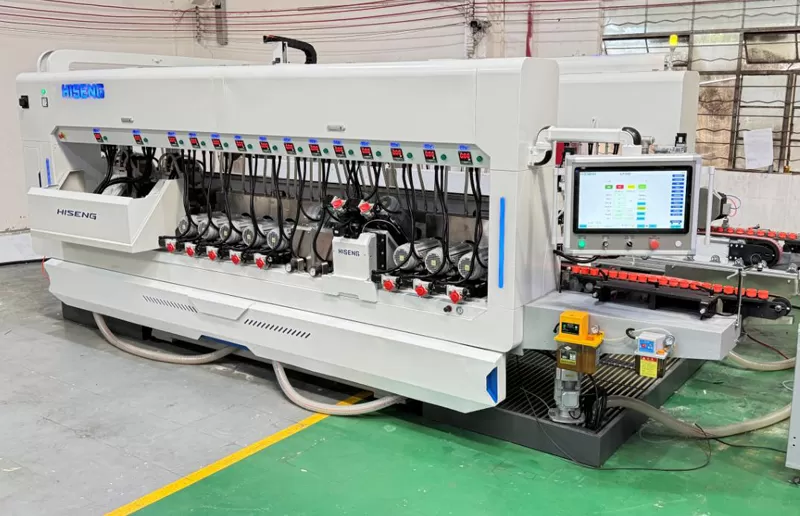
A Glass Bevelling Machine is a specialized industrial device that grinds and polishes the edges of flat glass at an angle, creating bevels—angled transitions between the glass surface and its edge. This process combines grinding and polishing to produce smooth, sloped edges that are both visually appealing and functionally superior to simple cut edges. The machines often incorporate multiple grinding wheels and polishing stages, allowing for a comprehensive bevel finish in a single pass.
Architectural glass often requires bevels ranging from subtle trim edges to functional chamfers that allow for better fitting in framing systems. Instead of manual finishing—which is time-consuming, inconsistent, and limited in precision—glass bevelling machines use computer control, automated conveyors, and precise grinding wheels to deliver consistent results at scale.
As HISENG integrates these technologies into its beveling solutions, customers benefit from reduced labor, faster turnaround, and uniform edge quality—critical for architectural glass where tolerances and visual quality are paramount.
In architectural glazing, aesthetics are a primary design consideration. Bevelled edges create elegant transitions of light and shadow, giving glass installations a premium, refined appearance. Bevels can add depth and dimension to glass panels used in:
Exterior facades with decorative glass elements
Glass curtain walls with angled edge trims
Glass canopies and skylights where light interaction enhances design
Partition walls and interior glass features that benefit from low-reflective edges
By using a Glass Bevelling Machine, architects and fabricators can achieve uniform bevel profiles that enhance natural light refraction and prominence of detailing. The precision offered by such machines ensures that each piece in a multi-panel installation matches in bevel width, angle, and finish quality—which is especially important in large-scale architectural applications where visual continuity is a must.
High-quality bevel finishes also integrate well with other architectural treatments, such as laminated or tempered glass layers, where edge quality supports both performance and spectacle.
Besides aesthetic benefits, bevelled edges contribute to enhanced safety and durability, a priority in architectural glass applications. Rough, unpolished edges are prone to chipping or cracking, which can compromise structural reliability, especially in high-traffic or exterior installations. A bevel transition removes sharp corners and spreads stress over a wider surface, helping to reduce the risk of damage.
For example:
Glass railings and balustrades: Bevelled edges minimize injury risk and improve the tactile feel.
Awning windows and storefronts: Smooth edges reduce stress concentrations at perimeter joins.
Glass doors and partitions: Finished beveled edges integrate with hardware more effectively.
Architectural glass must often meet strict building codes and safety standards. Bevelled finishes, produced by automated beveling machines, help fabricators comply with these requirements by delivering consistent edge quality that manual finishing cannot match.
As a reliable partner among glass bevelling machine suppliers, HISENG provides machines designed for high pressure, controlled grinding and polishing—ensuring edge strength is maintained across thicknesses commonly used in architecture.
Modern architectural projects frequently involve large glass panels and complex geometries. To keep pace with project timelines and quality benchmarks, fabricators rely on automated solutions. Glass Bevelling Machines dramatically increase throughput while delivering precision that manual methods cannot achieve.
With features such as:
Multiple spindle configurations for simultaneous bevel processing
PLC or CNC controls for automated angle and speed adjustments
Integrated conveyor systems for continuous production
These machines streamline the beveling process and minimize the need for secondary finishing steps.
Precision is also crucial when working with laminated or insulated glass units, where bevel accuracy impacts assembly fit and seal integrity. Automated machines ensure bevel consistency across multiple panels, reducing waste and rework. For large architectural orders, this capability translates into shorter lead times and greater reliability in delivery schedules.
Furthermore, advanced glass bevelling solutions from HISENG are engineered to be versatile, handling a range of glass thicknesses and applications—from sleek minimalist edges to broader decorative bevel widths.
From enhancing aesthetics and safety to improving production efficiency and consistency, Glass Bevelling Machines have become indispensable in architectural glass fabrication. Whether it's creating elegant facade elements, integrating bevelled edges with structural hardware, or ensuring smooth finishes for interior glass features, these machines deliver the precision and performance that modern architecture demands.
As one of the trusted glass bevelling machine suppliers, HISENG offers advanced beveling solutions that support the evolving needs of architects and glass processors—combining innovation with reliability for architectural glass excellence.
References:
Glass Edge Grinding 101: The Key to Safe and Beautiful Glass
Advantages of vertical systems for glass edge grinding

 EN
EN
 jp
jp  fr
fr  de
de  fa
fa  es
es  ru
ru  pt
pt  tr
tr  ar
ar  vi
vi