Automated loading and unloading systems for Glass Edge Machines use conveyors, robots, vacuum lifters, and smart control systems to move glass sheets safely and efficiently through edging lines. In modern glass plants, these systems are no longer optional add-ons; they directly affect throughput, labor cost, breakage rates, safety, and delivery speed.
As a global manufacturer of glass edging machines with more than 18 years of experience, HISENG helps processors integrate automation around Glass Edge Machines to improve productivity and support more stable quality in daily production.
Automation in glass edge processing refers to the use of mechanical and robotic systems to handle glass sheets with minimal manual intervention. The goal is to keep the line moving at a steady pace while reducing handling errors, operator fatigue, and accidental damage.
In a manual line, operators must lift, position, and transfer each glass sheet by hand. This limits throughput to what workers can safely manage and increases the risk of micro-scratches, edge impacts, and inconsistent feeding conditions. Automated lifters, suction-frame robots, and synchronized conveyors help glass move through the line at a more stable takt time, allowing Glass Edge Machines to run closer to their designed capacity for longer periods.
Automation also improves process consistency. When glass enters the machine in the correct position, orientation, and spacing, grinding and polishing heads work under repeatable conditions. That stability helps reduce rework, scrap, and variation in edge quality, especially for applications such as IG units, shower enclosures, and architectural glass.
Robotic and conveyor systems for glass edge processing are specialized handling devices that move, position, buffer, and discharge glass sheets in sync with Glass Edge Machines. The right configuration depends on product size, plant layout, throughput target, and the level of automation the factory wants to achieve.
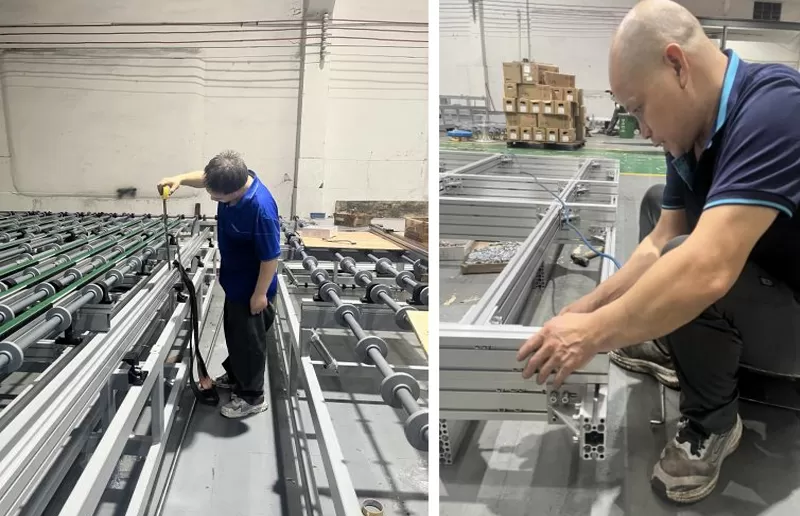
Common infeed systems include roller conveyors, tilt tables, and gantry robots with vacuum cups. These systems pick sheets from racks or carts and place them accurately onto the edging line. On the discharge side, outfeed conveyors, transfer shuttles, and stacking robots move finished glass to inspection, washing, tempering, or storage areas.
Layout flexibility is another important factor. Straight-line conveyors are ideal for simple high-volume production flows, while L-shaped and U-shaped layouts are better for compact workshops or plants that need to connect multiple processes in limited space. More advanced systems can also integrate with buffer storage modules to support automatic sequencing and dynamic routing between multiple Glass Edge Machines.
Automatic loading systems are designed to replace manual lifting and alignment with mechanized or robotic handling. This reduces direct labor demand and helps lower the cost of damage caused by unstable manual handling.
In many manual operations, large glass sheets require two to four operators per shift per line, especially when sheet sizes are above 2 m × 2 m. With an automated loading station, one operator can often supervise multiple Glass Edge Machines and only step in for exceptions, startups, or short production runs. That shift can significantly reduce direct handling labor while improving line consistency.
Breakage risk is another major reason to automate. Poor manual handling and collisions during loading or unloading are a frequent source of in-plant damage, especially in facilities with lower levels of automation. Vacuum lifters, fixed alignment stops, and controlled conveyor acceleration and deceleration all help reduce impact events and protect finished edges.
Safety also improves when fewer manual lifts are required. Glass handling is one of the most hazardous tasks in flat glass plants because of cut, strain, and crush risks. Reducing large-sheet manipulation not only protects operators, but also lowers hidden costs tied to downtime, insurance, and retraining.
Unloading system integration means designing the outfeed and downstream handling so finished sheets exit the machine safely, arrive in the right sequence, and move smoothly to the next process. A well-integrated unloading system is just as important as the loading side, because poor discharge handling can create bottlenecks even when the Glass Edge Machines themselves are running well.
The first factor is mechanical compatibility. Conveyor height, speed range, and working width must match the outfeed of the glass edge machine to avoid jamming or misalignment. Because edging machines usually have fixed pass heights and width ranges, the unloading system should be specified to fit those limits or equipped with adjustable guides and stands.
The second factor is process sequencing. If the glass continues to washing, tempering, lamination, or IG production, the unloading system should support order grouping and labeling so downstream operators can identify each piece quickly. Buffer conveyors and accumulation tables are often used to separate the edging line from the next process and give operators time to inspect sheets without stopping production.
Controls integration is also essential. When the edge machine and unloading conveyor share signals such as start/stop, jam detection, emergency stop, and speed reference, the entire cell works as one coordinated system. That reduces the chance of collisions at transfer points and makes troubleshooting much easier.
Selecting the right automation solution for a glass edging line means matching the handling system to your product mix, throughput target, available space, and budget. A good choice should improve ROI without adding unnecessary complexity.
A practical starting point is to compare your current manual output with your target throughput. For example, if a line currently processes 150 sheets per shift and you want to reach 230 sheets, you need a much more stable and continuous flow. In many cases, that means both faster changeovers and less idle time between sheets.
Glass type and sheet size also matter. Heavy, oversized, or coated glass usually benefits the most from automation because manual handling is more difficult and breakage is more expensive. For very low-volume or highly customized jobs, a semi-automatic solution may be more economical than a fully robotic cell.
Working with a specialized manufacturer such as HISENG allows you to design a customized configuration that includes edging machines, loaders, conveyors, and layout support based on your actual plant footprint. This system-level approach often reveals layout improvements, such as U-shaped lines or shared unloading cells, that can increase productivity without adding another machine.
| Solution Type | Typical Use Case | Investment Level | Labor Savings | Breakage Risk | Flexibility |
|---|---|---|---|---|---|
| Manual loading and unloading | Small workshops and very low volume jobs | Very low | None | Highest | High, but slower and less stable |
| Semi-automatic conveyors with manual lift support | Medium-size fabricators upgrading from manual lines | Low to medium | Moderate | Lower than fully manual | High, with some operator adjustment |
| Automatic loading with vacuum lifter and conveyors | High-volume architectural and furniture glass lines | Medium to high | High | Low | High, with recipe-based setup |
| Fully robotic loading and unloading cell | Large integrated plants with multiple Glass Edge Machines | Highest | Very high | Lowest | Very high, but requires engineering |
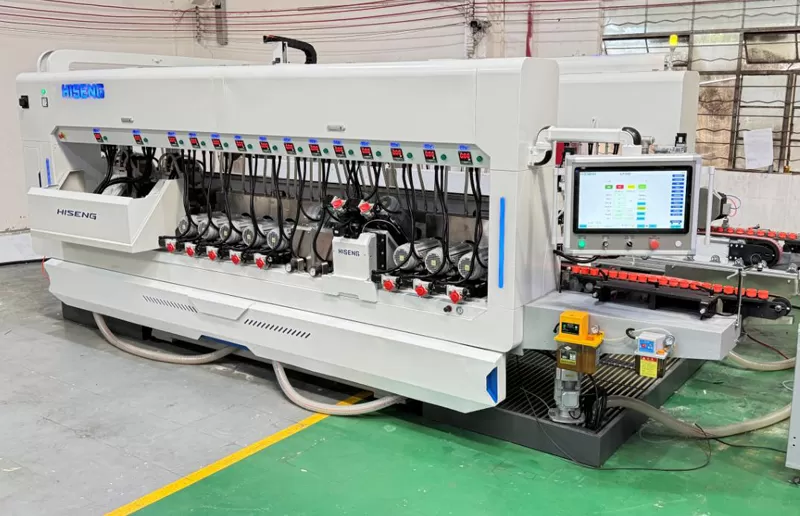
HISENG is a global manufacturer focused on glass edge grinding and polishing machines and related automation solutions for glass processors in more than 100 countries. The company provides straight-line, double-edging, and shaped glass edging machines, along with customized loading and unloading layouts designed to fit local plant conditions.
With in-house R&D, automated machining equipment, and laboratory testing capabilities, HISENG can tailor automation configurations to different product mixes, including architectural glass and household appliances. That flexibility matters because a loading and unloading system is only effective when it matches the actual production environment.
Planning an automation project around Glass Edge Machines is a step-by-step process that aligns production targets, space, and budget with the right technical solution. The most successful upgrades usually begin with a careful review of the current line rather than a full redesign.
First, map the material flow and identify bottlenecks such as waiting at the load table, backup at inspection, or delays at the outfeed. Measure baseline numbers like sheets per hour, breakage caused by handling, and the number of operators per line so you have a clear reference for improvement.
Next, define the automation level you want to reach, whether that is semi-automatic conveyors, automatic loaders, or a fully robotic cell. Then request layouts and proposals from equipment suppliers. A good manufacturer should be able to show how the conveyors, loading gantries, and unloading buffers will fit into your workshop and support future expansion.
Finally, build a financial model that includes capital investment, installation and training costs, labor reduction, and breakage savings. Even conservative assumptions can justify automation over a multi-year period, especially in markets where labor and glass costs continue to rise.
The main benefit is higher, more stable throughput with lower labor cost and less breakage risk, which improves the total cost per square meter of processed glass.
Depending on sheet size and product mix, moving from fully manual to automatic loading and unloading can reduce staffing by about 1–3 full-time operators per line per shift, based on typical industry staffing levels.
Yes, but the most economical solution is often semi-automatic handling (conveyors plus assistive lifting) that reduces strain and risk while keeping flexibility for frequent size changes.
For a standard conveyor-based system integrated with an existing glass edge machine, on-site installation and commissioning often take from several days to a few weeks, depending on complexity and site conditions.
In many cases, yes: existing machines can be paired with new infeed and outfeed conveyors or even robot cells, as long as mechanical and control interfaces are compatible or can be adapted.
Automation turns Glass Edge Machines from isolated workstations into high-performance production cells by improving loading, unloading, and in-line flow. With the right combination of conveyors, robotic handling, and control integration, processors can achieve higher throughput, lower handling-related breakage, better safety, and more predictable quality. By working with an experienced manufacturer such as HISENG, you can build an automation solution that matches your product mix, budget, and factory layout while leaving room for future expansion and digitalization. If you are planning an upgrade, the best next step is to start with your current line configuration and production target, then build the automation concept around those numbers.

 EN
EN
 jp
jp  fr
fr  de
de  fa
fa  es
es  ru
ru  pt
pt  tr
tr  ar
ar  vi
vi