Choosing the right glass edge machine affects much more than the appearance of a finished edge. It influences processing capacity, tempering yield, labor requirements, production-line layout and the total cost of every square meter of glass you produce.
The best machine is not necessarily the model with the highest speed or the largest number of grinding spindles. It is the machine that matches your glass applications, thickness range, edge profiles, daily output and automation strategy.
For most glass factories, the selection process begins with four questions:
What types of glass products will be processed?
What glass sizes and thicknesses must the machine handle?
What edge profiles and quality standards are required?
How much output does the factory need per shift?
This guide explains how to evaluate these factors and choose a suitable glass edging machine for architectural glass, furniture glass, appliance glass, solar glass and other industrial applications.
A glass edge machine is industrial equipment used to grind, polish, seam, bevel or shape the edges of flat glass.
After glass is cut, its edges may be sharp, uneven or covered with small chips. Edge processing removes these defects and produces the required edge geometry before the glass moves to tempering, laminating, insulating, printing or assembly.
Depending on the configuration, a glass edge machine may perform:
Rough grinding
Fine grinding
Edge polishing
Arris grinding
Chamfering
Beveling
Mitering
Round-edge processing
Special-shape grinding
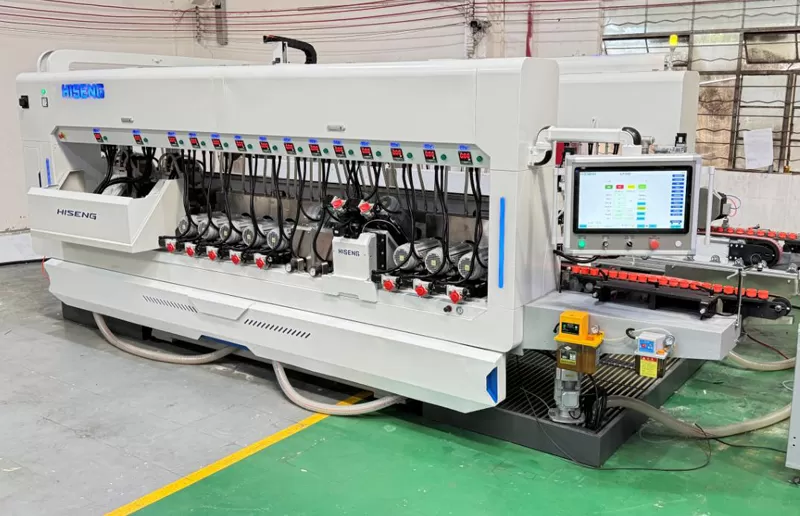
Modern machines may also be integrated with automatic measuring tables, loading equipment, transfer systems, washing machines and production-management software.
Different edge-processing machines are designed for different production conditions. Before comparing individual models, determine which machine category best matches your factory.
| Production requirement | Recommended machine type | Main advantage |
|---|---|---|
| Straight edges and varied glass sizes | Glass straight line edging machine | Flexible and suitable for general production |
| High-volume processing of opposite edges | Glass straight line double edging machine | Processes two parallel edges simultaneously |
| Rounded edges for appliances or solar glass | Double round edging machine | Consistent round-edge processing |
| Irregular glass shapes | CNC or special-shape grinding machine | Programmable processing paths |
| Arris removal before tempering or IG production | Glass seaming machine | Fast edge preparation with high throughput |
| Beveled decorative glass | Glass beveling machine | Produces controlled decorative bevels |
A glass straight line edging machine processes one straight edge during each pass. It is commonly used for furniture glass, shower doors, architectural panels and appliance glass.
This machine type is suitable when a factory processes different glass sizes, thicknesses or order quantities throughout the day. It normally requires less floor space and investment than a complete double edging line.
For example, the HISENG HSE-11S is designed for architectural and electronic glass. Its published configuration supports glass thicknesses from 3 to 25 mm and an adjustable grinding speed of 0.5 to 5 m/min.
A glass straight line double edging machine processes two opposite edges at the same time. After the glass is rotated or transferred, the other two edges can also be processed.
Double edging lines are normally selected for standardized, high-volume production such as:
Architectural glass
Insulating glass
Furniture panels
Appliance glass
Solar glass
Shower-door glass
Their main advantage is productivity. Automatic width adjustment, measuring, transfer and washing systems can reduce manual handling and help maintain consistent dimensions.
The HISENG HSDN L-Type line, for example, combines an automatic checking table, double edger, transfer table and washing machine. Its published configurations process 3–25 mm glass and support transmission speeds of up to 30 m/min, depending on the selected model.
A double round edging machine is designed to create rounded or pencil-shaped edges on two sides of the glass simultaneously.
It is particularly relevant for appliance glass, photovoltaic glass, shelves and other products where exposed edges must have a smooth, rounded profile.
Factories should verify the supported radius, glass thickness, edge symmetry and polishing result rather than selecting the machine only by its maximum speed.
A CNC or special-shape glass edge grinding machine is used for circles, curves, ovals and irregular profiles that cannot be processed efficiently on a conventional straight-line machine.
This type is suitable for:
Custom furniture glass
Decorative mirrors
Automotive glass
Special architectural components
Small-batch shaped products
It provides greater flexibility but is usually slower than a production line designed for standardized rectangular glass.
A glass seaming machine lightly grinds the sharp arrises created during cutting. It is often installed before tempering, insulating-glass assembly or coating.
Seaming is different from full edge polishing. Its main purpose is to remove sharp edges and small defects efficiently rather than create a decorative polished finish.
Start with the products your factory currently manufactures and the products it plans to produce in the future.
Architectural glass may involve large dimensions and heavy panels. Furniture and shower glass usually require more attractive polished edges. Appliance glass may require repeatable dimensions and high-volume production. Solar glass often requires fast, continuous processing of relatively thin sheets.
A factory producing many different custom orders usually needs flexibility. A factory producing a limited number of standardized sizes should place more emphasis on throughput and automation.
Do not select a machine based only on one current order. Consider whether the machine can support your expected product mix over the next several years.
Every machine has a minimum and maximum processing size.
Maximum size is important for façades, partitions, doors and jumbo architectural glass. Minimum size matters for shelves, appliance components and small furniture panels.
Ask the supplier to confirm:
Minimum glass length and width
Maximum glass length and width
Maximum supported glass weight
Stability when processing narrow glass
Handling method for large or heavy panels
A machine may technically accept a certain size but operate less efficiently near the limits of its specification. Sample testing is therefore important.
Common machines may cover ranges such as 3–25 mm, while specialized equipment may support thinner solar glass or heavier architectural panels.
Check both the nominal range and the machine’s performance at the thicknesses you use most frequently.
Important questions include:
Can the machine maintain stable pressure on thin glass?
Does thick glass require a lower processing speed?
How quickly can operators change between thicknesses?
Are recipes stored automatically?
Does the conveyor or clamping system require manual adjustment?
The widest thickness range is not automatically the best choice. Stable performance within your normal production range is more important.
Different machines produce different edge geometries. Common profiles include:
Flat polished edge
Flat edge with arrises
Pencil or round edge
Beveled edge
Mitered edge
Seamed edge
OG or decorative profile
Define the required profile before requesting quotations. A machine designed for flat polishing may not be suitable for round edges or adjustable-angle mitering.
Also specify measurable requirements such as arris width, bevel angle, dimensional tolerance and acceptable chipping.
Machine speed should be evaluated within a complete production process rather than as an isolated specification.
A high-speed edger provides limited value when cutting, loading, washing or tempering cannot maintain the same production rate.
Estimate the required capacity with the following calculation:
Required hourly output = Planned production volume ÷ Available production hours
Then add a reasonable operating buffer for:
Product changeovers
Wheel adjustment
Preventive maintenance
Inspection
Cleaning
Unplanned production interruptions
For mixed production, ask the supplier to calculate capacity using your real combination of glass sizes and thicknesses. Maximum transmission speed alone does not represent actual daily output.
The appropriate automation level depends on labor cost, production volume, available space and the maturity of the factory’s production system.
Possible automation functions include:
Automatic glass-size measurement
Automatic width adjustment
Recipe storage
Automatic spindle positioning
Servo-controlled movement
Automatic loading and unloading
In-line washing
Glass inspection
ERP or MES communication
Remote fault diagnosis
A small or highly flexible workshop may not need a fully automatic line. A large factory producing standardized glass may achieve lower labor cost and more stable output through integrated automation.
Check the communication interfaces before purchase if the machine will be connected to existing cutting, washing, tempering or factory-management systems.
Purchase price is only one part of the machine’s total cost.
A realistic comparison should also include:
Grinding and polishing wheels
Electricity consumption
Water and coolant treatment
Filters and other consumables
Preventive maintenance
Spare parts
Operator requirements
Installation and training
Production downtime
After-sales service
Future upgrade costs
Ask suppliers to estimate consumable usage based on glass similar to your products. A cheaper machine may become more expensive when it consumes wheels quickly, requires frequent adjustment or causes excessive downtime.
Architectural applications may involve large sheets, heavy loads and strict dimensional requirements.
Factories should prioritize:
Rigid machine structure
Stable conveying
Large-size handling
Parallelism control
Compatibility with tempering lines
Automatic measuring and transfer
For jumbo glass, verify the supported dimensions and weight rather than assuming a conventional double edger can handle every large panel.
Furniture and shower glass often have visible edges. Cosmetic appearance is therefore more important than in applications where edges are hidden inside frames.
Priorities normally include:
Uniform polishing
Consistent arris width
Low chipping
Smooth corners
Flexible size adjustment
Reliable processing across clear and low-iron glass
Request samples under strong lighting and inspect the edge from several angles.
Appliance manufacturers often need repeatable sizes and high production volumes.
Suitable machines should provide:
Consistent edge profiles
Fast recipe changes
Stable continuous operation
Automatic measurement
Integration with washing and inspection
Traceable production parameters
For rounded appliance edges, test the radius and polishing result on the actual product design.
Solar glass production emphasizes speed, thin-glass stability and continuous processing.
Important factors include:
Stable handling of thin sheets
High line speed
Low breakage
Round-edge consistency
Compact line integration
Compatibility with washing and inspection
The supplier should demonstrate that the machine can process the required thin glass without unstable conveying or excessive edge damage.
A machine should be evaluated through physical samples, not only specifications and videos.
Inspect the processed glass for:
Chips
Shelling
Grinding marks
Uneven polish
Burn marks
Inconsistent arrises
Incomplete corner processing
Visible differences between the beginning and end of the edge
Check samples under both wet and dry conditions. Water can temporarily hide grinding marks and small defects.
Measure:
Glass width and length
Parallelism
Diagonal difference
Arris width
Bevel angle
Edge straightness
Round-edge radius
Repeat measurements on several sheets rather than evaluating only one demonstration sample.
A good test should include:
Different glass thicknesses
Small and large sheets
Repeated production runs
Speed changes
Product changeovers
Glass from your normal suppliers
A machine may produce an excellent sample at low speed but fail to maintain the same quality during continuous production.
Where relevant, inspect the glass after:
Tempering
Washing
Laminating
Transport
Assembly
Edge defects can contribute to breakage during later processes, so the factory should evaluate the entire workflow instead of inspecting only the freshly ground edge.
Send representative glass samples or visit the supplier’s demonstration facility.
The trial should use your actual:
Glass type
Glass thickness
Minimum and maximum sizes
Edge profile
Required production speed
Quality acceptance criteria
Record the following information during the test:
| Test item | What to record |
|---|---|
| Processing speed | Actual stable speed, not only maximum speed |
| Edge appearance | Chips, marks, polish and arris consistency |
| Dimensional accuracy | Width, diagonal and parallelism |
| Changeover time | Time required to change size or thickness |
| Operator involvement | Manual adjustments required |
| Wheel consumption | Wheel type and expected replacement frequency |
| Cleaning result | Residue remaining after washing |
| Noise and vibration | Stability during continuous operation |
| Fault handling | Alarm clarity and recovery procedure |
Ask the supplier to document the final settings. These settings can later be used during installation and acceptance testing.
| Machine type | Best suited for | Output level | Flexibility | Typical automation |
|---|---|---|---|---|
| Straight line edging machine | Mixed architectural, furniture and interior glass | Medium | High | Manual loading with automatic processing |
| Straight line double edging machine | Standardized, high-volume rectangular glass | High | Medium | Automatic measuring, width setting, transfer and washing |
| Double round edging machine | Solar, appliance and rounded-edge products | High | Medium | Automated double-side processing |
| CNC or special-shape machine | Curved and irregular glass | Low to medium | Very high | CNC paths and recipe storage |
| Glass seaming machine | Pre-tempering and insulating-glass production | High | Medium | Automatic high-speed seaming |
| Glass beveling machine | Decorative furniture, mirror and architectural glass | Medium | Medium | Automatic bevel grinding and polishing |
Machine reliability depends on structural rigidity, spindle quality, transmission design, electrical components and maintenance access.
Before buying, inspect:
Machine frame and machining quality
Spindle vibration
Bearings and seals
Conveyor belts and chains
Lubrication system
Water protection
Electrical cabinet
PLC, servo and drive brands
Accessibility of wear components
Safety guards and emergency stops
Request a preventive-maintenance schedule covering daily, weekly, monthly and annual work.
Typical maintenance tasks may include:
Cleaning glass powder and coolant residue
Checking lubrication
Inspecting conveyor components
Replacing grinding and polishing wheels
Checking spindle condition
Verifying alignment
Cleaning water tanks and filters
Inspecting sensors and electrical connections
The supplier should also provide a recommended spare-parts package for the first one or two years of operation.
What are the minimum and maximum glass sizes?
What thickness range is guaranteed?
Which edge profiles can the machine produce?
What is the stable processing speed for our glass?
What tolerances can be maintained during continuous production?
How many grinding and polishing spindles are included?
Which wheel brands and specifications are recommended?
How long does a size or thickness changeover take?
Can the machine process coated or low-iron glass safely?
Can it connect with our existing production equipment?
Who will install and commission the machine?
Is operator and maintenance training included?
Is remote diagnosis available?
Where are spare parts stocked?
What is the typical response procedure after a breakdown?
Are local technicians or agents available?
Which maintenance documents are supplied?
Can the supplier provide reference installations?
What is included in the quotation?
Are loading, shipping, installation and training included?
Which consumables are required during the first year?
What utilities must the buyer prepare?
What is the warranty scope?
Can the machine be upgraded later?
What acceptance tests will be performed before shipment?
Which performance criteria will be written into the contract?
HISENG is a glass machinery manufacturer established in 2006. Its product range includes straight-line edgers, double edging machines, double round edging machines, glass seamers, washing machines, loaders and other glass-processing equipment.
According to the company’s published information, HISENG supplies automated glass-processing equipment to customers in more than 120 countries and regions and provides production-line integration with ERP and MES communication capabilities.
Relevant solutions include:
Glass Straight Line Edging Machine HSE-11S for flexible straight-edge processing
Glass Straight Line Double Edger Line HSDN L-Type for integrated grinding, polishing, transfer and washing
Double round edging machines for appliance and solar glass
Jumbo bilateral edgers for large architectural glass
Glass seaming machines for high-speed edge preparation
At China Glass 2026, HISENG also demonstrated a 32-spindle straight-line double edging machine configured for 3–50 mm glass and capable of completing corner rounding and polishing in one production step. This specification relates to the demonstrated production line and should not be treated as the standard specification of every HISENG double edger.
Factories considering a HISENG solution should submit their glass sizes, thicknesses, edge profiles and expected output so that the machine configuration can be evaluated against real production requirements.
A small factory processing varied orders will usually benefit from a flexible straight line edging machine. It requires less space than a complete double edging line and can process multiple sizes and thicknesses with relatively simple changeovers.
Choose a double edging machine when your factory produces large quantities of rectangular glass with repeatable sizes. It processes two parallel edges simultaneously and can be integrated with measuring, transfer and washing equipment.
The required number depends on the edge profile, stock-removal amount, polishing quality and target speed. More spindles allow additional grinding and polishing stages, but spindle count should not be used as the only measure of machine quality.
Most modern machines support a specified thickness range. However, production speed, wheel settings and stability may change at the upper and lower limits. Test your most common and most difficult thicknesses before purchase.
Edging produces a defined, often polished edge profile. Seaming mainly removes sharp arrises and small edge defects before tempering or insulating-glass production. Seaming is normally faster but does not create the same cosmetic finish as polished edging.
Standardize the specifications before comparing prices. Each quotation should cover the same glass sizes, thickness range, spindle configuration, automation level, accessories, installation, training, spare parts and acceptance criteria.
Not necessarily. The best machine is one that maintains the required edge quality at a speed compatible with cutting, loading, washing and downstream processing. Excess speed can create bottlenecks elsewhere in the factory.
Ask the supplier to process your own glass samples at the required speed. Inspect edge appearance, dimensions, arris consistency, changeover time and performance after tempering or other downstream processes.
The right glass edge machine should match your products, not simply offer the highest published speed or the most spindles.
Begin by defining your glass applications, dimensions, thickness range, edge profiles and required output. Then evaluate automation, line compatibility, edge quality, maintenance requirements and total ownership cost.
Before making a final decision, arrange a machine trial using your actual glass and establish measurable acceptance standards. This approach makes it easier to compare suppliers objectively and select equipment that can deliver consistent quality, reliable throughput and sustainable production costs.
For a more accurate machine recommendation, provide the supplier with your typical glass sizes, thicknesses, edge profiles, daily output and existing production-line layout.

 EN
EN
 jp
jp  fr
fr  de
de  fa
fa  es
es  ru
ru  pt
pt  tr
tr  ar
ar  vi
vi